Back to Class Page
Sara' s passion for needlework is credited to her mother-in-law, Anne. Sara had decided on a birthday gift for her husband, Baaron - a cross-stitch picture of 2 bears on a firetruck. As she herself didn't stitch, she intended to ask Anne if she would execute it. Anne professed her total confidence that Sara could complete the project herself. Sara did and now admits: "I think my husband sometimes wishes his mother had done the project for me because she unleashed a stitching addict." Sara then taught her sister, Ruth, to cross-stitch. In 1991 they attended the Spirit of Cross Stitch Festival in Des Moines and registered for classes in pulled thread work, Hardanger, and making a "band sampler." Since they had only stitched on Aida previously, they didn't realize they were about to make a huge stitching leap.
At a subsequent Spirit Festival Sara took the "Color Auras" class offered by the Caron Collection and immediately fell in love with their fibers and designs. She moved on to a variety of techniques: drawn thread, Hardanger, Blackwork, and multistitch projects which inspired her further: "I personally love band samplers because I like being able to do a lot of different stitches in a project. "
In 1996 Sara and Baaron moved to Colorado Springs where she began teaching at Irving Middle School which has about 1,000 students and is in the largest school district in Colorado Springs. When her needlework project was approved she began developing a curriculum for the class. She approached some local shops about providing discounts or sponsoring the class. She wanted to employ Caron fibers because she knew that they would be especially appealing to the students and Lois Caron sent her a packet of patterns to use.
 The
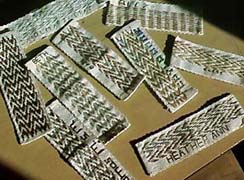
first project chosen was one Sara calls "That Darn Bookmark,"
modified to make it easier for the kids to do. For the second
project she decided an ornament would be perfect since it was
small, students could learn a variety of stitches and choose
their own colors. With the Color Auras ornaments as her inspiration,
she created her own design.
The
first project chosen was one Sara calls "That Darn Bookmark,"
modified to make it easier for the kids to do. For the second
project she decided an ornament would be perfect since it was
small, students could learn a variety of stitches and choose
their own colors. With the Color Auras ornaments as her inspiration,
she created her own design.
Three businesses contacted by Sara have proved invaluable:
Ruth's Stitchery* in Colorado Springs, the Caron Collection and
Zweigart Fabrics. She elaborates: "Ruth's Stitchery provided
me with discounts on supplies... Ruth gave my students a tour
of her shop and provided examples of the different techniques
that needlework encompasses. She also showed my students the
huge array of products that are available to stitchers. It is
fun to see them looking at all of the fibers, beads and patterns
available. Ruth's also has featured my students as her "Stitchers
of the Month" for the month of 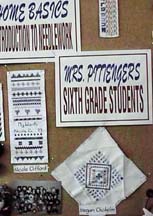 May
the last two years. The Caron Collection provided me with numerous
patterns as well as some samples of floss. Jim Kornecki at Zweigart
has listed me as a designer, which allows me to purchase fabric
at a discount. With the help of these three businesses I have
been able to keep the cost of the class to under $15.00 per student.
Our school provides scholarships for students that need financial
help."
May
the last two years. The Caron Collection provided me with numerous
patterns as well as some samples of floss. Jim Kornecki at Zweigart
has listed me as a designer, which allows me to purchase fabric
at a discount. With the help of these three businesses I have
been able to keep the cost of the class to under $15.00 per student.
Our school provides scholarships for students that need financial
help."
Most students do not know much about needlework when they
begin. The mix of students is broad including both boys and girls
from the Gifted and Talented program, to regular education, to
Special Education. 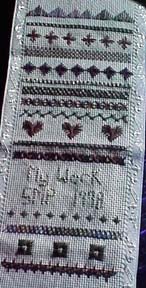 Sara
emphatically stresses: "My philosophy is that every student
will succeed." In teaching this project, Sara breaks it
down into very small steps and sequences them in a way conducive
to success. She describes this approach: "On the first day
I describe what we are going to do...I also show them many types
of needlework and some different uses for needlework. We discuss
the use of color, different fibers, beads, metallics, and why
fabric count is important. Day two is the day I pass out their
"kits." Each student receives two pieces of "doodle"
cloth, some pins, and a needle...I have them choose a color of
6-strand floss...We discuss how to separate the strands and practice.
The third day is spent threading the needle...I teach them how
to read a stitch diagram. The needle usually goes from the back
of the fabric to the front of the fabric on odd numbers and from
the front of the fabric to the back on even numbers. We also
talk about counting threads, not holes...I then start teaching
stitches that they will be using...I chart the stitches on the
board and demonstrate on a large stitching frame... I give them
time to practice the stitch and then let them "play"
with it...At this point some students are starting to make designs
on their doodle cloths; I point these out to the rest of the
class. .Before our fieldtrip to Ruth's [Ruth's Stitchery Shop]...I
pick out Wildflowers as the base fiber for the ornament...When
we are at the shop they get to pick out 2 or 3 solid colors of
6 strand floss, a metallic (number 8 braid), and Mill Hill beads.
I have found that 2 students can divide all of the supplies and
have enough materials to complete an ornament and a band sampler."
Sara
emphatically stresses: "My philosophy is that every student
will succeed." In teaching this project, Sara breaks it
down into very small steps and sequences them in a way conducive
to success. She describes this approach: "On the first day
I describe what we are going to do...I also show them many types
of needlework and some different uses for needlework. We discuss
the use of color, different fibers, beads, metallics, and why
fabric count is important. Day two is the day I pass out their
"kits." Each student receives two pieces of "doodle"
cloth, some pins, and a needle...I have them choose a color of
6-strand floss...We discuss how to separate the strands and practice.
The third day is spent threading the needle...I teach them how
to read a stitch diagram. The needle usually goes from the back
of the fabric to the front of the fabric on odd numbers and from
the front of the fabric to the back on even numbers. We also
talk about counting threads, not holes...I then start teaching
stitches that they will be using...I chart the stitches on the
board and demonstrate on a large stitching frame... I give them
time to practice the stitch and then let them "play"
with it...At this point some students are starting to make designs
on their doodle cloths; I point these out to the rest of the
class. .Before our fieldtrip to Ruth's [Ruth's Stitchery Shop]...I
pick out Wildflowers as the base fiber for the ornament...When
we are at the shop they get to pick out 2 or 3 solid colors of
6 strand floss, a metallic (number 8 braid), and Mill Hill beads.
I have found that 2 students can divide all of the supplies and
have enough materials to complete an ornament and a band sampler."
*Note: Ruth's Stitchery is featured as our Shop Focus this month.