A Special Presentation from the Premier Issue of Quilting Arts Magazine
Winter 2001 Volume One Number One
By Rosina Lippi
Crazy quilters love the jumble of junk stores. There is simply
nothing better than finding potential where others have conceded
defeat. A madeira-work handkerchief singed on one side, a single
tarnished earring with a bright blue bead, a torn sweater trailing
a mother of pearl button, a butter mold without a handle that
will still make an impression on cloth, these are the things
to make our hearts beat faster. We ignore locked glass cases
where intact collectibles are protected from dust and curious
fingers. No mint christening gowns or perfect Nancy dolls for
us: we create our own masterpieces from the ruins others have
left behind
It might seem that crazy quilters would be immune to the obsessions
of collectors who agnize over hair line cracks and pulled threads,
and to some extent, this is true. A real crazy quilter would
never have been caught up in the Tulip Mania of seventeenth century
Holland, when a single bulb went for the price of a house.
A crazy quilter -- if crazy quilts had existed in that time
and place -- would have shook her head over neighbors who paid
three times the cost of a Rembrandt for a solitary bulb. Then
she would have gone tend to her own cottage garden, bursting
with colors and shapes and textures in unusual combinations.
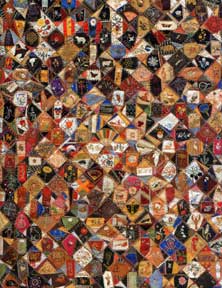
Quilt by Victoriene Parsons Mitchell (1893)
Courtesy of The Indianapolis Museum of Art
But the fact is, we are not immune to obsession. Anyone who
has wandered through the maze of auctions on Ebay knows that
crazy quilters can be drawn in, and pay dearly for it. We love
old silk buttonhole twist on wooden spools, wedding veils, cigarette
silks, antique kimonos and brocades, beads and bangles, ribbons
of all kinds.
We will pay for these things, and overpay for them, but the
single biggest craze in the world of embellished quilting must
be Penny McMorris's Crazy Quilts, a book first published
in 1984 with a modest print run of 7,500 copies.
This beautifully composed book on the history of the art is
full of glossy color photos of crazy quilts from museums and
private collections across the country. It is the only book that
provides such an overview, but the timing was off and it was
out of print by 1990, before the current upsurge in interest.
Thus was the stage set for a new obsession, the Holy Grail of
crazy quilters: an out-of-print book just a 127 pages in length.
In the summer of 2000, a copy of Crazy Quilts went for
$169 in an Ebay auction, almost ten times the original cover
price of $18.95. This bid is especially surprising given the
fact that in the same time period, an antique Victorian crazy
quilt with extensive embroidery and hand-painted velvet went
for just $170, a dollar more. In the same month another crazy
quilt -- dated 1899, signed and in very good condition -- failed
to get even a single bid at the opening price of $160.
How is it that we are more interested in pictures of quilts than
in the quilts themselves? In this issue's interview with Penny
McMorris, she suggests that this has less to do with her book
than it with how fragile antique crazy quilts can be.
But I have another explanation. I'd like to think that it
all makes perfect sense. Crazy quilters want the McMorris book
because it provides inspiration and stories about other women
just like us. Women who used what they could find to make something
their own. Women with a passion for transforming the forgotten
and discarded into the personal and unique and useful. Those
who have little interest in collecting other people's work, no
matter how beautiful or historically significant.
Take for example Victoriene Parsons Mitchell, who took the
ten years from 1883 to 1893 to create her crazy quilt, now in
the collection of the Indianapolis Museum of Art. A quilt which
I would never have seen if not for the fact that Penny McMorris
decided to include it in her book.
Victoriene is a stranger to me, and yet I know so much about
her, because I have studied her quilt with its stunning juxtaposition
of color and shape. Most of all it is her motifs which provide
clues about the way she saw the world, with humor and insight:
birds watching over a nest, a rabbit in a wagon being drawn by
another rabbit, flowers and cats and rats. And women.
I wonder what could have been going through Victoriene's head
when she embroidered the figure of a woman without an arm and
with snaky blond hair, Venus de Milo and Medusa both; half a
damaged goddess of love and half the beautiful serpent goddess
of destruction. What woman who is also a wife and mother cannot
identify with that image? Or with Victoriene's most interesting
and disturbing motif: a woman dangling, naked and upside down,
in a web of her own making.
 --
--
Details from Quilt
Crazy quilters collect bits and pieces that we can transform
into something new. We admire the quilts that other women have
created, but in general we aren't driven to own them. Rather
than spend thousands of dollars on a quilt like Victoriene's,
we put that money into carved buttons and needle lace, silk
thread and velvet, and to these beautiful things we add the pieces
of our own lives: a husband's shirt tail, a child's pinafore
hem, a mother's handkerchief, a piece of a wedding dress, an
army uniform, a lace collar. We have our own stories to sew,
stitch by stitch. That is the real nature of our obsession.
For subscription or other information,
go to the Quilting Arts Website:
http://www.quiltingarts.com